




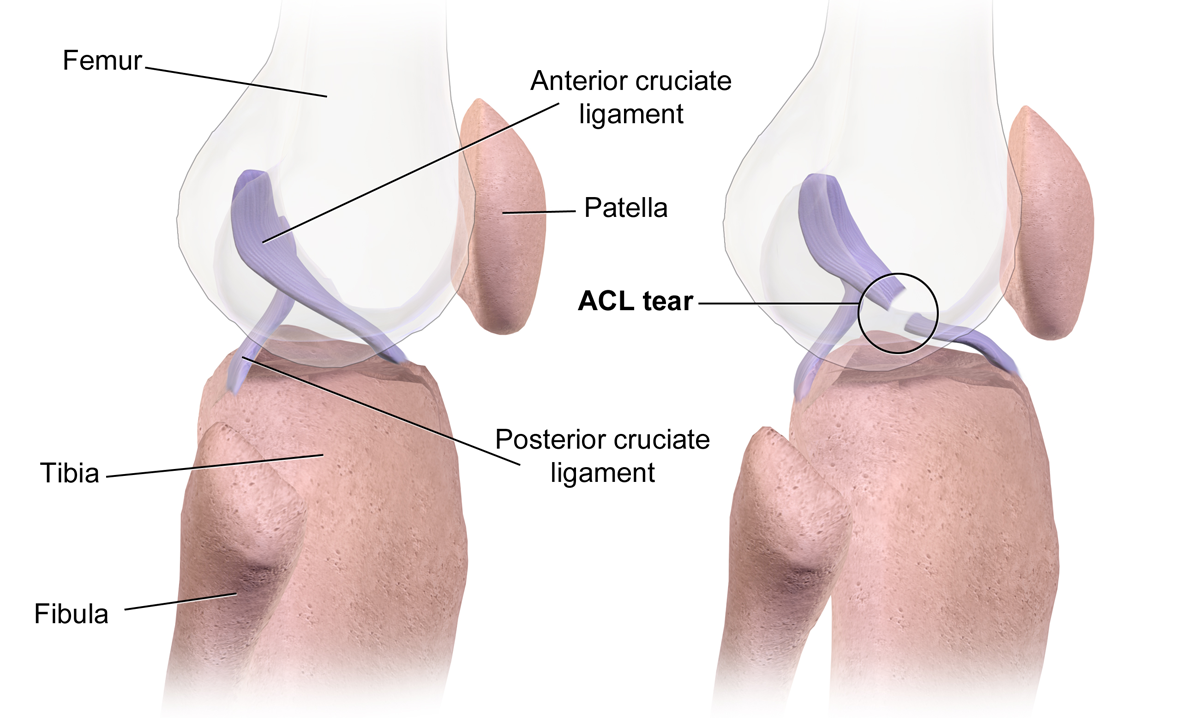
If a soccer player suffers a non-contact ACL injury it typically won’t be purely accidental and will likely result from several physical forces. The main causes of ACL strain would be high grip on their cleats, gender differences, and fatigue during the late stages of play.
Turf and Cleats
One of the main causes of knee injury comes from the interaction between the players cleats and the surface. Many soccer fields use rubber infill to replicate the feel of natural grass; however, this can cause issues with increased friction (Loud et al 6). If players make a sharp cut or change direction quickly and have longer or bladed studs, then their cleat can get caught in the turf. This means when the player tries to move their body, but their foot is locked in place huge amounts of force go up their leg and put huge strain on their knee. To reduce this risk, it is recommended to use shorter, rounder studs on an artificial surface. (Cicchella and He 5).
Gender Differences
Soccer players of the female gender have a much greater risk of suffering a non-contact ACL tear. After puberty this gap gets even bigger as females can often experience sudden increases in body weight and leg length which can happen quicker than their muscles can cope (Howard et al 5). As they get tired towards the end of the game their muscles become fatigued. This leads to them having less stiffness in their joints and less stability when landing from a jump meaning their knee is much more at risk (Howard et al 5).
What We Can Do
To prevent these injuries, we should ensure the players have the correct equipment and training. Coaches and athletic trainers should ensure players are wearing the correct cleats for the surface they are playing on. (Greig and Siegler 4). Putting a focus on endurance and muscle development can help prevent knee injuries caused by fatigue (Anderson et al).
Citations
Anderson, T., E. B. Wasserman, and S. J. Shultz. “Anterior Cruciate Ligament Injury Risk by Season Periodand Competition Segment: An Analysis of National Collegiate Athletic Association Injury Surveillance Data.”Journal of Athletic Training, vol. 54, no. 7, 2019, pp. 787–795. https://doi.org/10.4085/1062-
Cicchella, A., and J. He. “A Systematic Review of Effects on ACL Injury of Soccer Shoe Outsoles, SoccerPlaying Field Surfaces, and Outsole–Surface Interface.” Encyclopedia, vol. 4, no. 2, 2024, pp. 888–899. https://doi.org/10.3390/
Greig, M., and J. C. Siegler. “Soccer-Specific Fatigue and Eccentric Hamstrings Muscle Strength.” Journalof Athletic Training, vol. 44, no. 2, 2009, pp. 180–184. https://doi.org/10.4085/1062-
Howard, Mark, et al. “Epidemiology of Anterior Cruciate Ligament Injury on Natural Grass Versus ArtificialTurf in Soccer: 10-Year Data From the National Collegiate Athletic Association Injury Surveillance System.”Orthopaedic Journal of Sports Medicine, vol. 8, no. 6, 2020. https://doi.org/10.1177/
Loud, D., P. Grimshaw, R. Kelso, and W. S. P. Robertson. “Effect of Soccer Boot Outsole Configuration onTranslational Traction Across Both Natural and Artificial Playing Surfaces.” Orthopaedic Journal of SportsMedicine, vol. 12, no. 8, 2024, article 23259671241259823. https://doi.org/10.1177/